AI for Environmental Sustainability
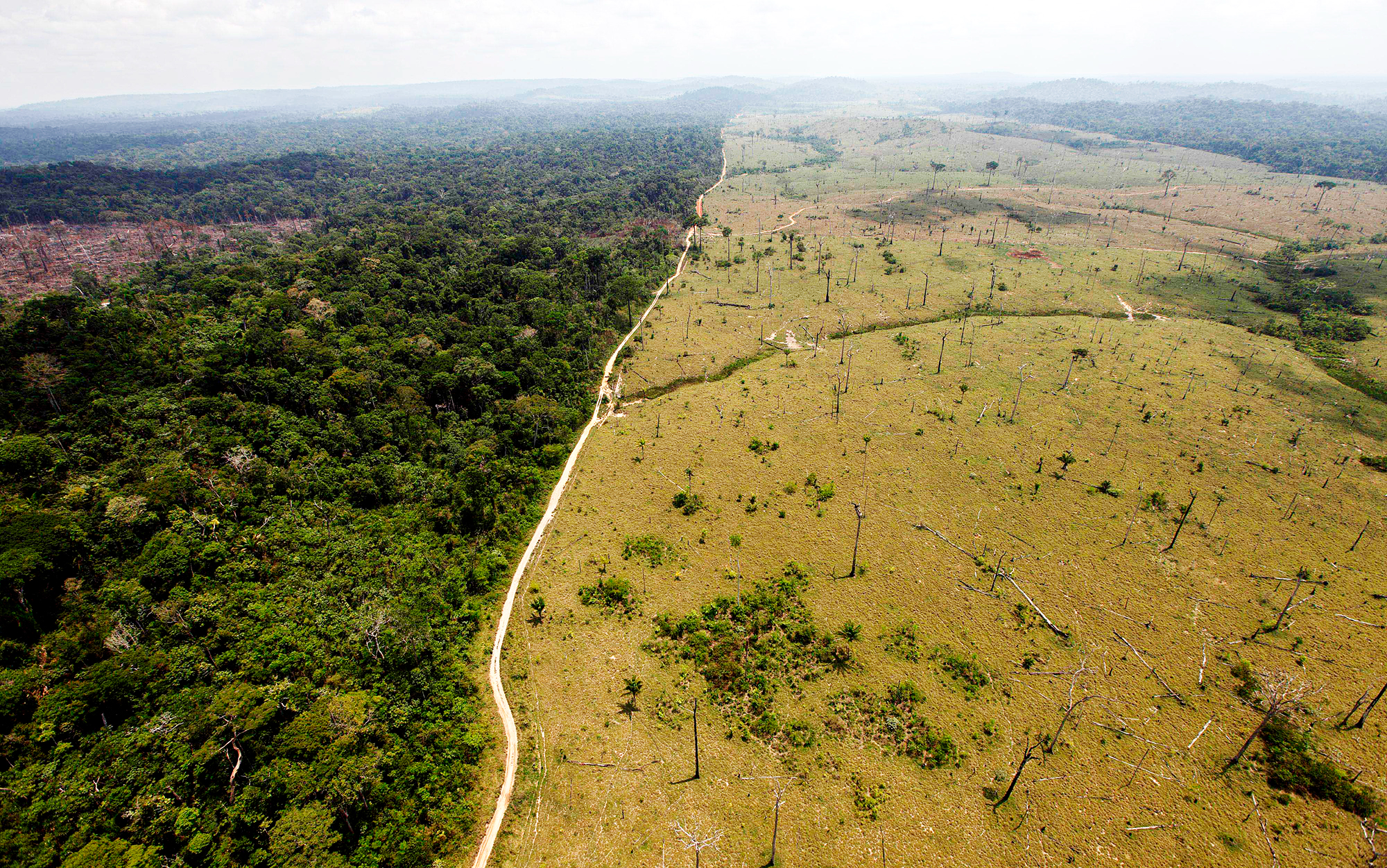
Environmental Sustainability is an extremely important global issue being faced today; particularly the security and protection of our wildlife and natural resources, where all around the world they are being threatened by human behavior such a poaching, deforestation, over fishing and encroachment. This project is ongoing work in collaboration with several non-govermental organizations such as Panthera, WWF, WCS and AVG, developing game theoretic models and security software to help optimize the protection of these important resources.
In general, game theory for security focuses on the fundamental challenge of allocating limited security resources to a number of targets. Green security games deals specifically with challenges in the protection of forests, fish and wildlife - here we take a motivating examples the the problem of optimizing the defense of forests against illegal logging. Illegal logging is a major problem with severe economic and environmental impact, costing up to USD $30 billion annually and threatening ancient forests and critical habitats for wildlife. As a result, improving the protection of forests is of great concern for many countries. Unfortunately in developing countries, budgets for protecting forests are often very limited. We focus on deploying resources to interdict the traversal of illegal loggers on thenetwork of roads and rivers around the forest area. However, we must first choose the right security team for interdiction; there are many different organizations that may be involved — from local volunteers, to police, to NGO personnel — each differing in their interdiction effectiveness and with varying costs of deployment. Our challenge is to simultaneously select the best team of security resources and the best allocation of these resources.
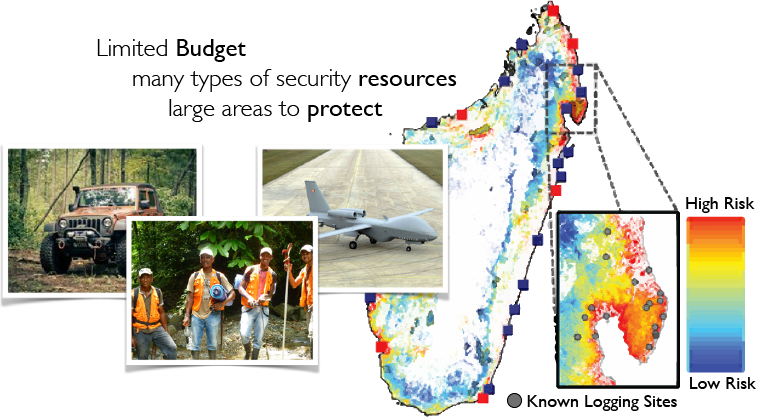
Team Building Problem
What team of resources should we invest in?
Deployment Problem
How do we maximize the protection of the forest? How do we best deploy our team of resources?
This work introduces a new, yet fundamental problem: Simultaneous Optimization of Resource Teams and Tactics (SORT). SORT contrasts with most previous game-theoretic research for green security - in particular based on security games - that has solely focused on optimizing patrolling tactics, without consideration of team formation or coordination. In our approach to SORT, we integrate the analysis of the strategic and tactical aspects of the problem to search the space of teams much more efficiently. Our algorithm FORTIFY uses successive relaxations of the security game to evaluate potential teams; as we explore the search space of teams we add more detail to our models, tightening upper bounds on the values of teams and allowing us to prune away any sub-optimal teams.
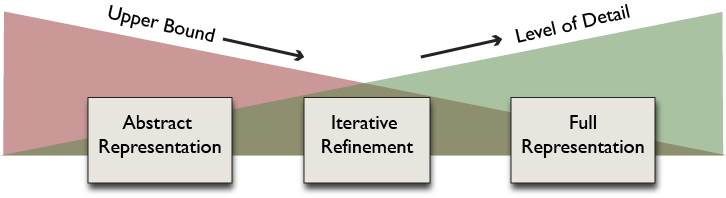
We evaluated this work on a real-world case study using data from our on-going collaboration in Madagascar. We see here the GIS data from an at risk park in madagascar. With this data we compared the level of protection (here measured with utility) acheived using the optimized team chosen by the Fortify algorithm compared to the average level of protection acheived using all other teams of the same cost. Note that we are measuring utility as the expected loss due to an attack.
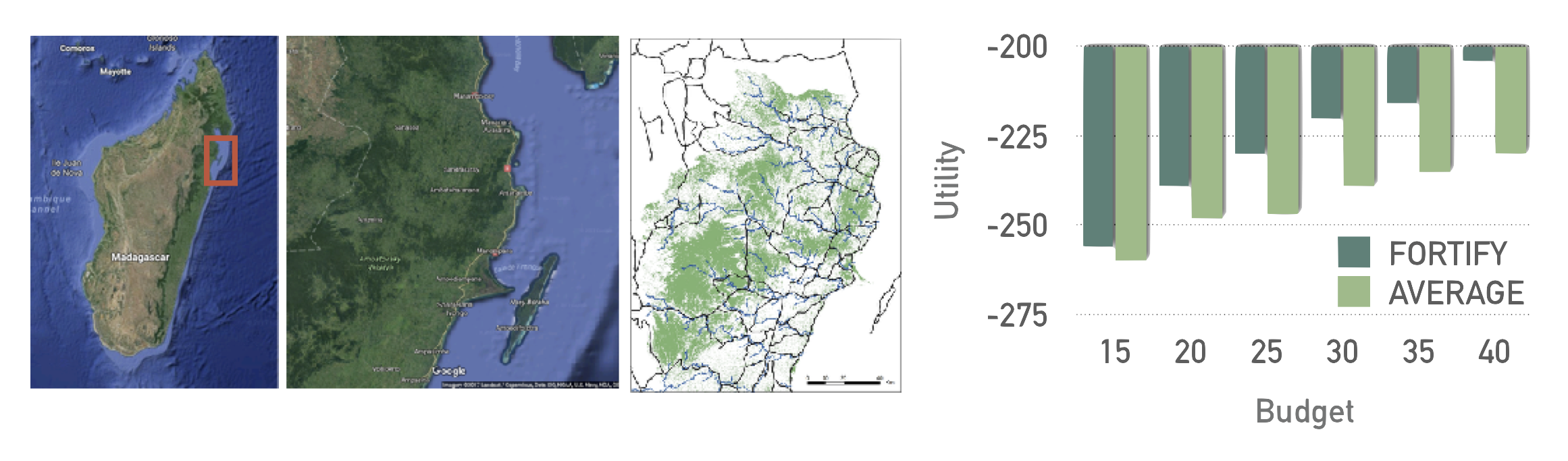
We can see significant improvements in utility when we optimize over team members, particularly as our budget for investment in resources (and thus the number of possible teams) grows.
SMART: Spatial Monitoring and Reporting Tool
SMART is a free, open source software application that allows conservationish to collect, analyze and evaluate data on patrol efforts, patrol results, and threat levels. In collaboration with the World Wildlife Fund (WWF), Wildlife Conservation Society (WCS) and Panthera, we have been working on integrating our predictive and prescriptive models into the SMART software. This will allow conservation areas all around the world access to our game theoretic and machine learning software which allow them to perform predictive analysis to better determine where attacks and signs of disturbance are likely to occur and to plan patrols in order to maximize their interdiction of these illegal activities and deterrant effect of the patrols.
Relevant Publications
- Sara Mc Carthy, Milind Tambe, Christopher Kiekintveld, Meredith L. Gore, Alex Killion. Preventing Illegal Logging: Simultaneous Optimization of Resource Teams and Tactics for Security. In Proceedings of the Association for the Advancement of Artificial Intelligence (AAAI) 2016
- Shahrzad Gholami, Sara Mc Carthy, Bistra Dilkina, Andrew Plumptre, Milind Tambe, Margaret Driciru, Fred Wanyama, Aggrey Rwetsiba, Mustapha Nsubaga, Joshua Mabonga. Adversary models account for imperfect crime data: Forecasting and planning against real-world poachers. In International Conference on Autonomous Agents and Multi-agent Systems (AAMAS 2018)
Media Coverage
- Outwitting poachers with artificial intelligence. NSF Article.2016